
Why We Reimagined the Most Widely Shared Image in Racial Justice Work
March 3, 2026
In the context of racial justice work, there is a well-known graphic used to depict the journey from inequality to justice. Various versions of this visual tool exist, but at its most fundamental it contains a series of panels depicting people whose view of a baseball game is obstructed by a fence. Using boxes or crates to improve their view, each panel shows a progressively more equitable scenario than the last, measured by how many people are able to see over the fence.
In November last year, Our Director of Research and Development, Dr Kũi Mackay, was preparing to facilitate an anti-racism strategy development workshop. Initially, the intention was to use an existing version of the graphic. However, Kũi identified a number of limitations with the existing frameworks that made them unsuitable for the work she was trying to do.
It was never a model for visualising liberation.
The creator of the original image, Craig Froehle, provides a detailed account of the graphic’s evolution, noting that he initially created it in 2012 not as a model for racial justice, but to make a point in a political argument. In his own words:
I was trying to clarify why, to me, 'equal opportunity' alone wasn't a satisfactory goal and that we should somehow take into consideration equality of outcomes.
Craig Froehle
He assembled the image in PowerPoint in around half an hour, using a stock photo of a baseball park, a crate, and some clip art then posted it on Google+. Below is Froehle’s original image.
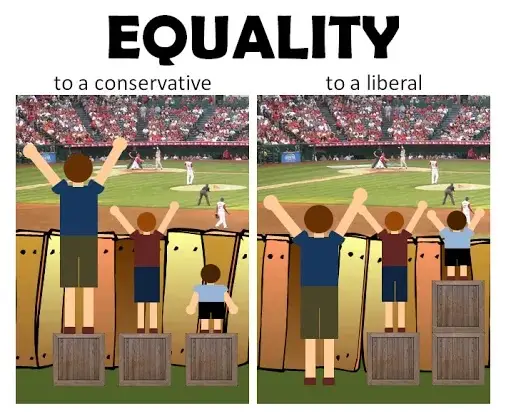
Since then the image has been reproduced, remixed, and reinterpreted across countless contexts, adapted by a range of organisations and translated into multiple languages.
The version that we think has done work that resonates with us is the four-panel framework developed by the Center for Story-based Strategy in collaboration with the Interaction Institute for Social Change. First published in 2016, their #the4thBox framework added the concepts of liberation and justice, introducing the idea of removing the fence altogether rather than simply helping people see over it.
And yet, even with this powerful evolution, we found ourselves wanting to go further.
Liberation is not a spectator sport
The image is ability focused. It assumes the “problem” is seeing over a fence, which is a very specific type of access need. This is a deficit model. It locates the problem in the individual rather than in the system that built the fence in the first place. But beyond that, the metaphor positions us as spectators watching a game from the sidelines. As Black feminists, and as members of an organisation that has collective responsibility in its name, we are not spectators in the fight for our own liberation and justice.
There is also much to be said about what is being observed. The choice of sport is not neutral. Baseball is a predominantly North American cultural reference point, and knowing the origin of this image and who it was created for, that makes sense. However, once it travelled beyond its original context and was taken up as a racial justice framework, it began to rely on the assumption that watching a baseball game is a universally relatable experience. It also says a lot about who its gaze is oriented towards.
This is something that is evident in an adaptation documented by Froehle. Writing about the University of Sydney’s School of Physics version, he noted,
leave it to the Aussies to replace my baseball background scene with a cricket match (and to also get some girls involved)." This small adjustment successfully highlights the cultural assumptions baked into the original.
Craig Froehle
We did not want to simply swap one sport for another. We wanted to move away from the spectator metaphor altogether. Others have also moved away from the spectator metaphor. One example replaces the fence and baseball game entirely, depicting two people attempting to reach fruit from a tree, with ladders representing inequality, equality, equity, and justice respectively.
And yet, the reason we felt we needed to go further is perhaps best captured in Froehle’s aside about the Australian cricket adaptation. In parentheses, he notes that the Australians also got “some girls involved.” This points to our next issue regarding how representation functions within these images.
Marginalised people are not the problem
This deficit model extends beyond the spectator metaphor and into who is represented in the graphics. At least some of the people in these images are supposed to be representative of marginalised communities. This presents three distinct challenges. The first is who is depicted and, just as importantly, who is absent. The second is how they are depicted. The third is that the attempt at representation can replicate harm and reinforce stereotypes.
In the visualisations that contain people, there are usually three people and there is often a marked difference between them. Most notable (and sometimes the only) difference between the three figures is their height. In the versions that depict people looking over a fence, height becomes the marker by which privilege and disadvantage are assigned, but this carries a lot of ambiguity. Is the shortest figure an adult or a child? If it is a child, it raises questions about how age is conflated with height and how this combination becomes a proxy for disadvantage. More broadly, what is being communicated when height is used as a stand-in for inequality?
Some versions attempt to depict gender diversity among the figures. However, in doing so they rely on visual codes such as clothing, body shape, and hair to signal gender. Rather than representing gender diversity, this approach upholds a cisheteropatriarchal framework that reinforces gender binaries and positions the male-coded figure as the least disadvantaged.
The same issues arise when we consider race. Some versions make no attempt at racial representation whatsoever, featuring monoracial figures. Those that do attempt it typically reduce the full complexity of race to three shades: a dark brown, a light brown, and a beige. Three shades cannot adequately represent the breadth of racial diversity, and the selection of those particular shades is itself a choice that communicates something about who is centred and who is absent.
We realised that for a visualisation to work, we had to shift the visual attention away from people, especially marginalised people. The way these images are constructed positions marginalised people as the problem to be solved rather than as people navigating systems designed to exclude them.
This led us to pay attention to the structures.
Our Reimagining
We wanted to create an alternative that genuinely centred the dismantling of systems and structures. A model that pointed towards liberation for all, not just better access for some.
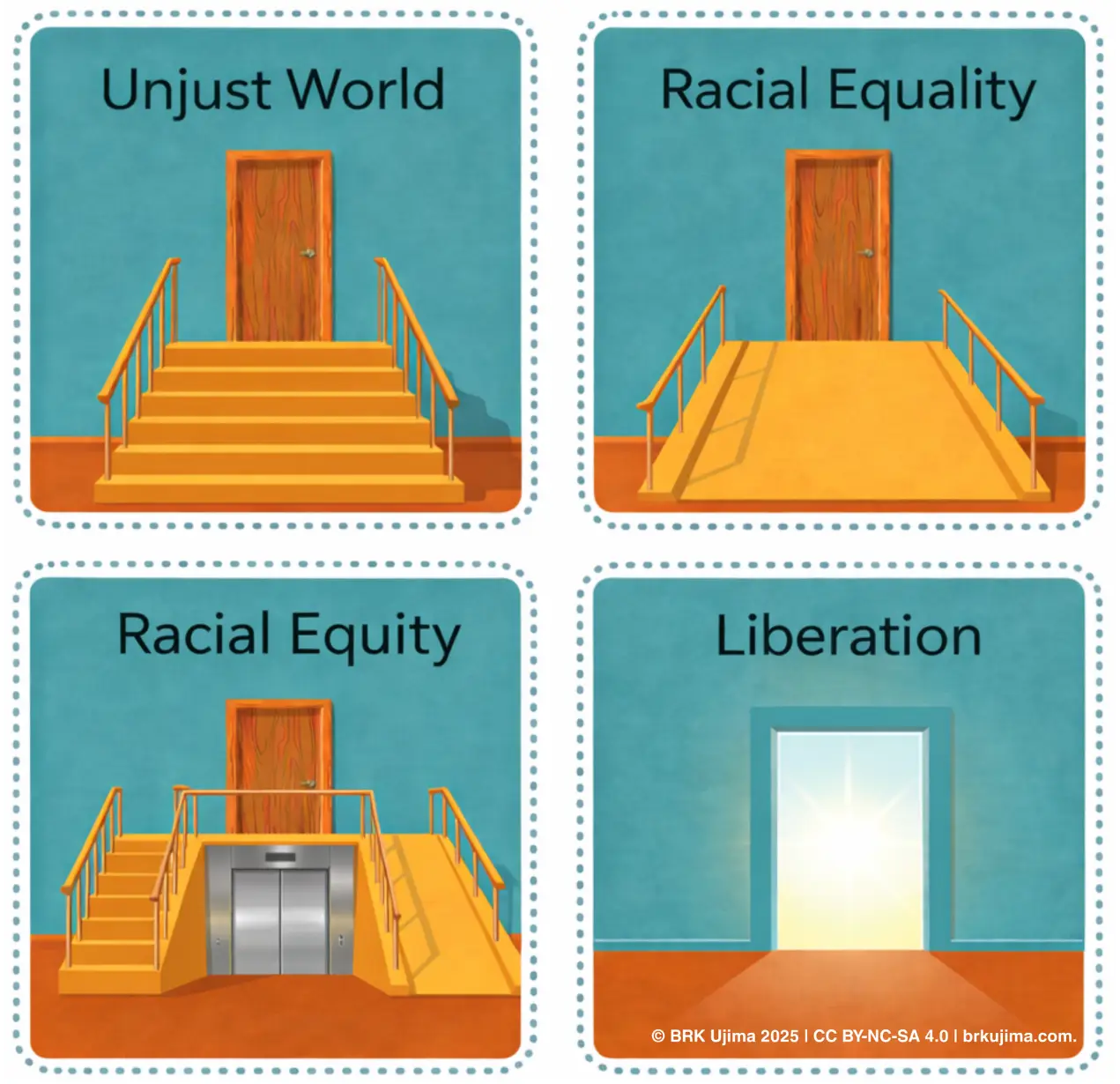
What follows is our visualisation, along with an explanation of each panel
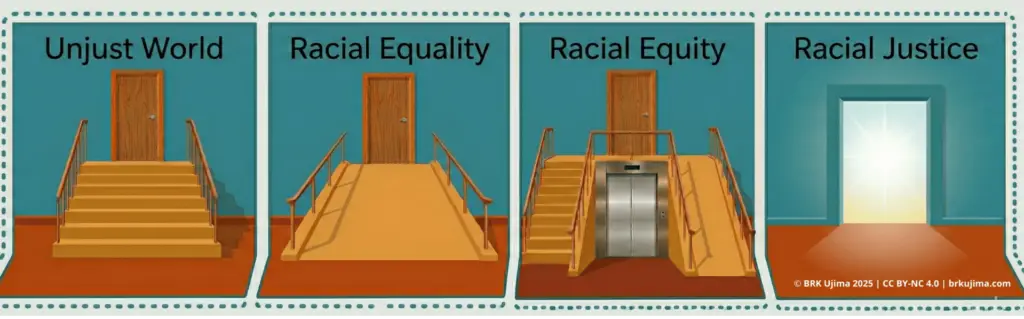
Panel 1: An Unjust World
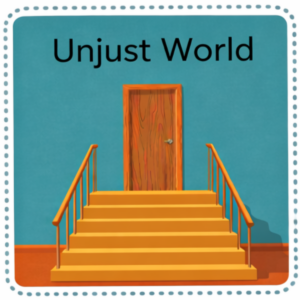
In this image, the locked door represents systemic oppression. On the other side of the door is liberation. There are people who are born on the other side of the door. The rest of us are trying to get there.
The elevation represents structural oppression. The stairs are presented as a solution to the structural oppression, however they also function as a barrier. Not everyone can use the stairs to overcome the barrier presented by elevation.
For those who do make it to the top, there will be those who have a key, so they can unlock the door and make their way to liberation. Those without a key remain beholden to those who do.
Additionally, not everyone who passes through will hold the door open for the next person.
Finally, even when the door is opened, its narrowness means that only a limited number of people can pass through at a time. The path to liberation becomes a queue, meaning that for some people, there is a very long wait. To paraphrase a well known saying, liberation delayed is liberation denied.
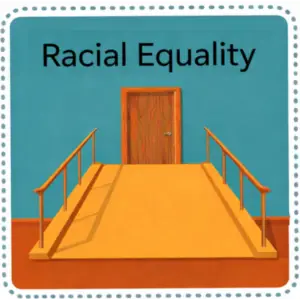
Panel 2: Racial Equality
Panel 2: Racial Equality
A racial equality framework recognises that the stairs are a problem and offers a solution: a ramp.
For some this is more accessible and perhaps easier to navigate than the stairs. But the ramp does not address the fundamental issues. The elevation still remains, the door is locked, and the doorway is still narrow. Racial equality offers everyone the same solution to the structural barriers, but it does not remove these structural barriers. It also fails to address the exclusion caused by the systemic oppression the door represents.
Panel 3: Racial Equity
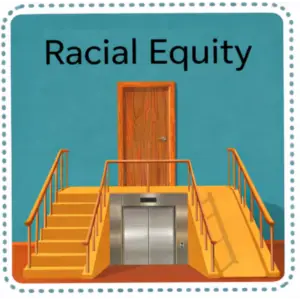
A racial equity framework goes a step further. It offers everybody alternatives. In this panel there is a ramp, a lift, and stairs for those who need them. These multiple pathways give the impression that more people are closer to liberation.
However, all this has done is diversify responses to the structural barriers. The elevation, which is the original structural barrier, remains unchanged. Most importantly, systemic issues persist. People are still confronting a locked door and a narrow doorway.
Much like the stairs in Panel 1 were both a response to a barrier and a barrier in itself, this racial equity response can actually amplify the impact of systemic exclusion. It is a visual representation of diversity initiatives that do not address wider systemic issues. Hiring more Black people into an institutionally racist organisation does not dismantle the racism. It simply subjects more people to it.
Panel 4: Liberation
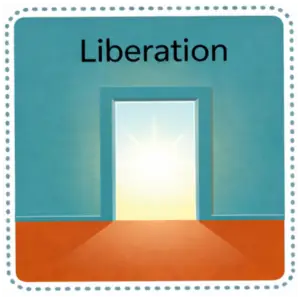
In this panel, we keep at the fore of our minds the fact that there are some people who were born on the other side of the locked door. Our intention is to ensure that those who were not born on that side can get there in a manner that closely reflects how easy it was for those who were. We do this by first removing the structural barrier: the elevation. Doing so negates the need for stairs, ramps, or lifts. Likewise, we dismantle the systemic barrier represented by the locked door and the narrow doorway. The power held by those who could unlock the door is neutralised. There is no longer any need to queue.
Liberation work can never stop with temporary responses, no matter how necessary they may be in that moment. It is about providing permanent solutions that require us to dismantle and eliminate oppression at every level. This is what the other panels could not offer. Their focus was on better ways to navigate barriers, whereas liberation means nobody has to navigate anything. We can just be free.
Where We Go From Here
We present this new visualisation as part of an ongoing conversation rather than a final destination. In the spirit of the original graphic, the tradition of adaptation that has grown around it, and the Black cultural practice of remixing, we are releasing this into the world. We are asking people to build on it, to challenge it, to share it. We desperately need to develop the language that enables us to accurately name the barriers we face. We are at a moment in time where we need new ways to articulate what racial liberation looks like.
This work is licensed under a Creative Commons Attribution-NonCommercial-ShareAlike 4.0 International licence. You are free to share, remix, and adapt it for non-commercial purposes, provided you attribute it to BRK Ujima and license any adaptations under the same terms.
Using our images
If you share or adapt our visualisation, please credit it as follows:
© BRK Ujima 2025, licensed under CC BY-NC-SA 4.0. Available at brkujima.com.
Note: Our reimagined four-panel visualisation was created using AI image generation tools.